Welcome to simplepso’s documentation!
simplePSO is a full implementation of the PSO algorithm. It requires an objective function to minimize that returns a scalar value, starting position, bounds on how far you want to search around the starting position, and max speeds each particle can travel. Then, you set the number of particles in the swarm, the number of iterations to run, and the number of processors you want to use. That’s it!
# Here we initial the class
# We must provide the cost function and a starting value
optimizer = PSO(start=start_position)

# We also must set bounds of the parameter space
optimizer.set_bounds(parameter_range)
# set speed limits on updating particles
optimizer.set_speed(speed_min, speed_max)

# Now we run the pso algorithm
optimizer.run(num_particles, num_iterations, num_processors,
              cost_function)
# get best parameter fit
best = optimizer.best
# parameter set
best.pos
# fitness of parameter set
best.fitness
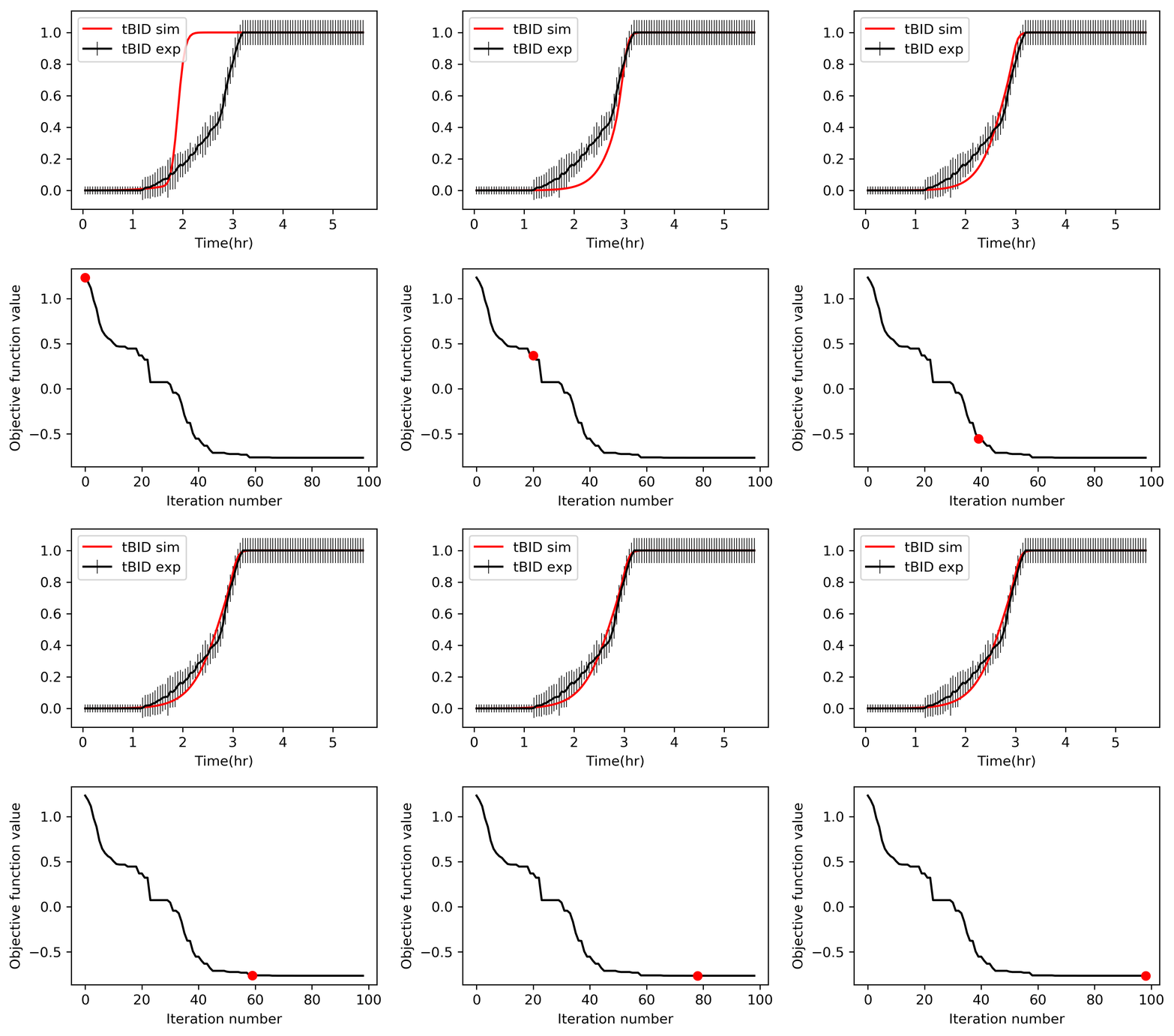
We provide two examples in the examples folder training PySB models to time course data using ODE simulations and one example training a model to a distribution of species concentrations using stochastic simulations.
-
class
simplepso.pso.PSO(start=None, save_sampled=False, verbose=False, shrink_steps=True)[source]¶ Simple interface to run particle swarm optimization
- It can optimize parameters for a function using two run methods.
- run()cost function gets a parameter vector and returns a scalar. Can
be used with any callable function.
- run_ssa()cost function gets multiple trajectories of a PySB model
and returns a scalar. These trajectories are provided as a pandas.DataFrame. PySB dependent function.
-
__init__(start=None, save_sampled=False, verbose=False, shrink_steps=True)[source]¶ - Parameters
- startlist
Starting position
- save_sampledbool
Save each particles position and fitness over all iterations.
- verbosebool
- shrink_stepsbool
Shrink max distance traveled by each particle as the number of iterations increases
-
return_ranked_populations()[source]¶ Returns a ranked population of the particles
- Returns
- np.array, np.array
-
run(num_particles, num_iterations, cost_function=None, num_processors=1, save_samples=False, stop_threshold=1e-05, max_iter_no_improv=None)[source]¶ Run optimization
- Parameters
- num_particlesint
Number of particles in population, ~20 is a good starting place
- num_iterationsint
Number of iterations to perform.
- cost_functioncallable function
Takes a parameter set and returns a scalar (particles fitness)
- num_processorsint
Number of processors to run on. If using scipy, note that you may need to set OMP_NUM_THREADS=1 to prevent each process from using more than one CPU.
- save_samplesbool
Save ALL positions of particles over time, can require large memory if num_particles, num_iterations, and len(parameters) is large.
- stop_thresholdfloat
Standard deviation of the particles’ cost function at which the optimization is stopped
- max_iter_no_improv: int
Maximum steps allowed without improvement before the optimization stops.
-
run_ssa(model, num_particles, num_iterations, num_sim, cost_function, simulator, save_samples=False, stop_threshold=0)[source]¶ Run PSO for a stochastic simulator
- Parameters
- modelpysb.Model
- num_particlesint
Number of particles in the swarm.
- num_iterationsint
Number of iterations to perform
- num_simint
Number of SSA simulations to run for each particle.
- cost_functionfunction
Takes a pandas dataframe of PySB trajectories created by running multiple SSA simulations. Function must return a scalar.
- simulatorpysb.Simulator
PySB simulator (CudaSSASimulator or OpenclSSASimulator)
- save_samplesbool
- stop_thresholdfloat
-
set_bounds(parameter_range=None, lower=None, upper=None)[source]¶ Set the search space bounds that the parameters may search.
This can be a single float, in which the particles can search plus or minus the starting values around this. It can also be an array that must be the same length of the starting position.
- Parameters
- parameter_rangefloat
If provided parameter_range, the range will be set by the starting position +/- this value. To set each parameter manually, use lower and upper args
- lowerarray
Lower bounds for parameters
- upperarray
Upper bounds for parameters
-
set_speed(speed_min=- 10000, speed_max=10000)[source]¶ Sets the max and min speed of the particles.
This is usually a fraction of the bounds set with set_bounds. So if one sets the bound to be +/- 1 order of magnitude, you can set the speed to be -.1 and .1, allow the particles to update in 1/10 the parameter space. This keeps particles near their local position rather than jumping across parameter space quickly.
- Parameters
- speed_minfloat
- speed_maxfloat
-
set_start_position(position)[source]¶ Set the starting position for the population of particles.
- Parameters
- positionarray
-
all_fitness¶ History of all particles finesses over all iterations. Only saved if save_sampled=True
-
all_history¶ History of all particles positions over all iterations. Only saved if save_sampled=True
-
best¶ Best Particle of population
-
history¶ Best particle for each iteration
-
population¶ Population of particles
-
population_fitness¶ Fitness values of population of particles
-
start¶ Starting position
-
values¶ Fitness values of the best particle for each iteration